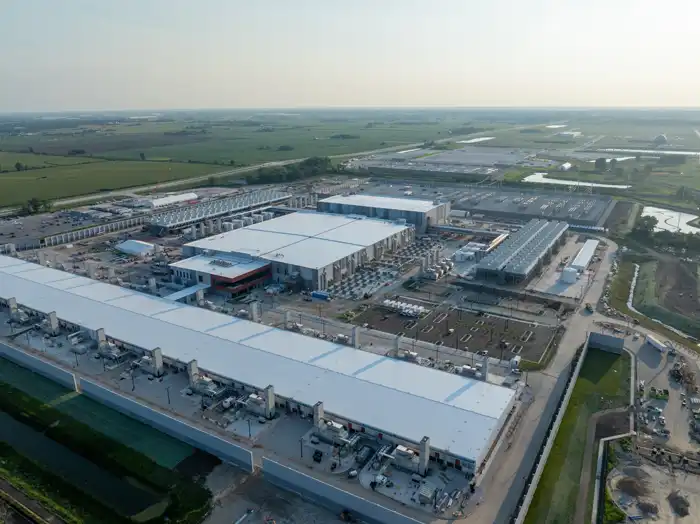
A campus of four million square feet consumes both materials by the acre, every working day, for years, and because concrete and asphalt are perishable, you can't build a stockpile to draw from. The material has to be produced fresh, nearby, and on time, in volumes few suppliers in any region can sustain. Feeding a site like that is a logistics problem as much as a construction one, and it's where a lot of large projects quietly struggle.
Ready-mix concrete and hot-mix asphalt both have a short working life, so they can't be shipped far or stored. Supplying a project this size means producing them close to the site, in high volume, and timing every truck to the work in the field. Sustaining that flow without a gap is the whole of it, because a gap stops the job.
Why these materials are different
Most building materials can wait. Steel, lumber, and equipment can be ordered ahead, delivered early, and stored until needed. Concrete and asphalt can't, and that single fact shapes everything about how a large site is supplied.
Ready-mix concrete begins curing the moment it's batched, giving it a working life measured in hours. Hot-mix asphalt has to leave the plant hot and reach the road inside a narrow window before it cools past the point of being workable. Neither one tolerates distance or delay. You can't produce a week's worth on Monday, and you can't truck it in from two states away. The material has to be made close to where it's placed, at the rate it's placed, which is why proximity to production is one of the largest factors in whether a big project holds its schedule.
Perishability would be manageable if the quantities were small. On a hyperscale campus, they aren't.
A site this size carries extensive foundations, heavy structural slabs engineered to hold up power, cooling, and racks of equipment, and acres of paved roads, lots, and laydown yards. Each of those scopes draws on concrete or asphalt in quantities that dwarf a normal building, and they run concurrently across a site more than a mile long. Sustaining that over a multi-year build means plant capacity sized to the work, a fleet of trucks large enough to keep the cycle unbroken, and the batching discipline to produce material to spec, in volume, day after day. A supplier that can handle the volume but not the consistency, or the consistency but not the volume, can't carry a job like this.
Even with production close by and capacity to spare, the material still has to arrive at the right moment. This is the part that looks simple and isn't.
On a large pour, trucks are timed so concrete arrives in a steady rhythm, fast enough that the crew never waits, spaced enough that no truck sits and stiffens. On a paving run, the same logic governs the asphalt: the paver should never stop for material, and material should never cool waiting for the paver. Coordinating that across a site with multiple crews working at once, each with its own appetite and schedule, is a daily exercise in logistics, and it's where experience shows. The plants, the trucks, and the field crews have to operate as one system, because the moment any link falls behind, the others stall.
A contractor that buys its concrete and asphalt depends, every single day, on an outside supplier's capacity, fleet, and priorities, and on a project this size, that dependency is the largest schedule risk on the job. When the supplier has a good day, the work flows. When it doesn't, crews and equipment sit idle, and because the material is perishable, the lost time can't simply be made up later.
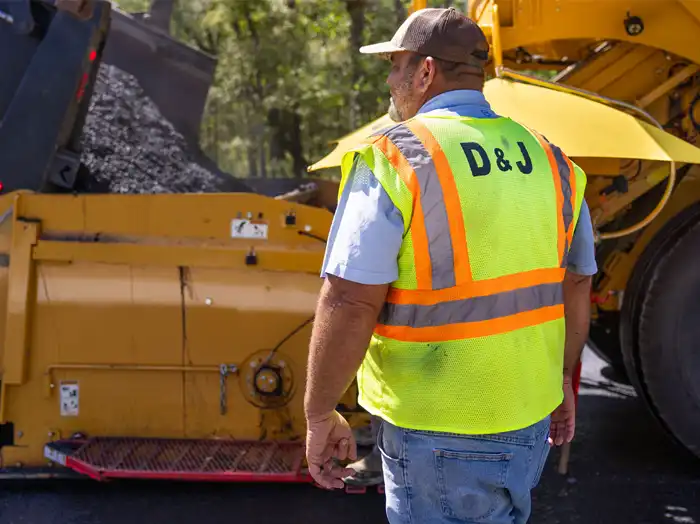
A contractor that produces its own materials removes that risk entirely. The plant answers to the same schedule as the crew, the trucks run to the same plan, and a single organization owns the whole chain from batch to placement. That is how Trinity is built. On the Meta data center in Rayville, River City Ready Mix produced the concrete and Trinity's own plants supplied the asphalt, with D&J Construction placing it. The material moved from production to pavement inside a single group of companies, without one outside handoff. On a build measured against a national schedule, owning both the material and the crew is what keeps the flow from depending on anyone else.